Monday, 1 November 2010

Analytics for ShareThis, AddThis, AddToAny and SocialTwist

You recognize the services offering Social Bookmarking and Sharing by the buttons you see announcing 'Share this in facebook' on many websites nowadays. When you use these services, you share a URL of a page on your favourite social network or email service. There are a lot of free services which cover an amazing number of services and in this post, I compare the Analytics features they offer.

The services I'm comparing in this post are:
  1. SocialTwist
  2. AddToAny
  3. AddThis
  4. ShareThis
All these 4 services offer all of the following features:
  • They include a huge list (some 300+) of social networks where the page can be shared.
  • They all do bookmarking and emailing.
  • They all come in a lot of languages.
  • The are all free.
One of the main differences is their approach to Analytics. When used the right way, these services can provide very good social media metrics: you can see how many times your site or page is shared and in which social media. You can track how many people click these shared links and how many visits your site gets back.
A lot has been discussed on social media metrics. Consider this a solid and important first metric when defining your KPIs for Social Media: how do people share your content and does it drive traffic to your site. It's not yet a metric which tells you qualitatively how people value your brand or site, but it's a first useful step.

Here are my findings of how the above mentioned 4 services offer Analytics.

1. SocialTwist
You can find the analytics for Social Twist ('Te!! a Friend') within their own site: you create a login to get the service and the stats are found within the platform. For the free subscription, you just get to see the times your page or site was shared in 'Social', 'Bookmark' or 'Email', without any breakdown. And you get to see what is the most used service, but not more. You can upgrade to a 'Pro' account (100$ each 1000 referrals) and you can get more detailed analytics. Social Twist doesn't offer integration with Google Analytics or any other Web Analytics platform. You can't measure traffic coming back from the times your page was 'shared'.


2. AddToAny
AddToAny doesn't have any statistics on their own platform, but they do have an integration with Google Anlytics. The integration is automatic: as soon as you have a Google Analytics script on your page, you get the 'Shares' tracked as events. AddToAny doesn't offer a way to track if people get back to your site after it was shared.
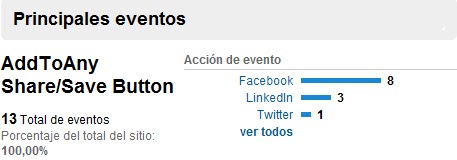

Little parentesis: AddToAny is the only one of the 4 who let's you share on Tuenti. Tuenti is a ver important social network in Spain, and it's quite amazing that the other services just doesn't offer this option on their platform. Why?

3. AddThis
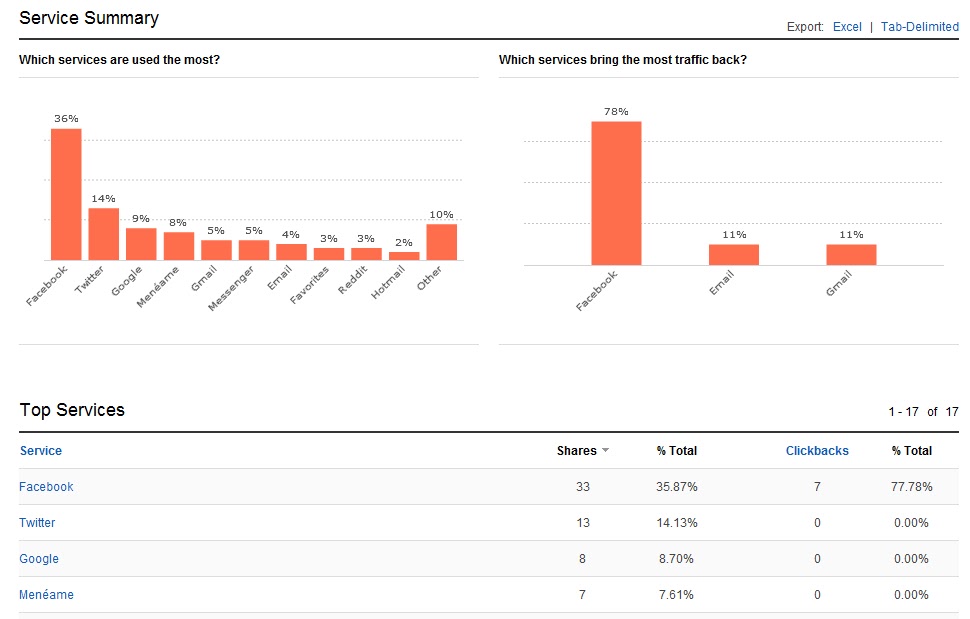
AddThis is good on analytics. You have a very nice interface on the AddThis site using your login. You get different features: top shared content, tops services used, geography.
You also get to see Click-backs: the number of visits who come from people clicked a shared URL of your site.
There is a pretty easy integration with Google Analytics, and you can also integrate it with Omniture.


On top of that, there is a freely accessible application which shows the most used services over the world, you can breakdown and compare countries, and every service has a little 'resume' which shows you where it is popular. A lot of data, which you can access here. Do you know what services are mostly used in your country?


4. ShareThis
Social Twist and AddThis give you some data, AddThis is better since it offers some analysis. But ShareThis is the one who goes all the way and provides real insights based on 'Shareing' behaviour.
First of all, ShareThis does everything that AddThis does: their own site has an analytics dashboard, and you have integrations with Google Analytics and Omniture.
They have something called 'Social Reach', which is very similar to what AddThis calls 'Click-Back': it measures how many people click on the links which are shared via ShareThis.
But the really BIG thing is this: ShareThis is the most used service of sharing, and is now starting to use all this data to give something as precious as competative analysis. You can actually compare the data from your site with data from similar websites: for instance, I can see how my blog is doing compared to other small blogs.
Second, I can check how my site performs versus other sites from my catagory (for example, you can compare against 'Automotive'). And ShareThis is even working on a 'know-your-audience' feature, which indicated that your site is popular for sharing for people interested in, say, 'Music' and 'Family'.


2 Important Remarks

1. Data integration is important, so I completely understand that some people will argue that another analytics interface might not be what is needed right now.
2. Note that all 4 features are external services. So when using them, you are giving access to your site to an external provider to obtain data. The competative analysis features from ShareThis can work in your advantage, since you can compare your data with competitors. But it is important to think about provacy and sensative data you are actually giving away for free.

So what's next?
If you'd ask me, we're missing a feature which measures Click-backs or Social Reach crossed with the conversion of our site goals, like brochure downloads, access to a demo, or buying a product. It's nice to know your site is shared in social media, it's better to know that people click on the shared link to come back to your site. But no doubt, it will be massive to see how many of the people coming back to your site via facebook convert in prospects. Since the sharing scripts are implemented on almost all pages, and they track which pages are shared, it can't be too difficult to let site-owners define what the goals on their site are and integrate them on the analytics dashboards.

¿Who will be the first to provide this feature?

Related post:
Track click-backs from Facebook


Share this post:

Sunday, 24 October 2010

Track click-backs from 'Share this in Facebook'

On almost every web page today, there is some kind of 'Social Bookmarking' installed. Social Bookmarking is the method of posting a site or a page in a social network, like Twitter or LinkedIn. Every time you press a link which says 'Share this with your friends in Facebook' you are 'social bookmarking'.
What you actually do with social bookmarking is posting a link on your wall in facebook or on your twitter status. This is important for people managing a website. First of all, every link counts as an incoming link, which is good for Organic Search results (SEO).
But maybe more important: it means an extra links to your site, which can mean extra visitors and extra conversion/subscriptions/revenue for your site. And it's very probable that you get good quality visitors: a friend has recommended  to visit the page, and a friend's recommendation is always a good thing.

It's impressive, which so much links and external provider offering solutions for Social Bookmarking, that so few people actually bother with trying to measure how many people actually get back to your site from a Social Bookmark.

In this post, I'll explain how to measure the incoming traffic for visitors coming from social bookmarking on Facebook. This is: somebody shared a link of a site on Facebook, and one of his friends or connections sees the link and clicks on it to visit the site.

¿How does social bookmarking on facebook work?

Sharing a link on Facebook is very easy: you just need to use the following URL:

http://www.facebook.com/sharer.php?u=here-comes-the-url-you-want-to-share

After the parameter 'u=' you insert the URL of the page you want to share. Say that I want to share the blog of my friend Michael Notté, Kaizen-Analytics, then I need to use the following URL:

http://www.facebook.com/sharer.php?u=http://www.kaizen-analytics.com

It's interesting to note that you can include every page on a share this link or button. It doesn't have to be he page where you put on the link or button hat needs to be shared.

When you use this URL, say as a text link or a button on your site, you'll get to see this:


As you can see, there are 4 things published by facebook:

The title of the page
The URL of the page
A description of he page
An image found on the page

The title and the description are both taken from the so-called 'Meta Tags' of the page. For every page you can give a small title and a description. This is generally used for search engines: the 'title' is what you see in blue on a page of the search results and the 'description' is the little bit of text you see on the page of the search results.

This is good to know: you can make a separate 'landing page' for sharing in facebook. Like you've seen above: you can implement any URL in the facebook-share page so technically there is no problem using any URL you choose. So you can make a personalised landing page, in which you can personalize the Title and the Description as you please. This can be a nice way to make a special offer to somebody who comes 'recommended by a friend'.

It's not really clear on what basis facebook selects the images you get to share with the URL mentioned above. But it looks like it just takes all images from the body of the page and you can change to the one you like most.

The trick for measuring the incoming traffic from this link mentioned above is the URL. Instead of including just the link of the page we want people to share, we're going to add some parameters to the URL so that, when somebody clicks on the URL, we can track this.

How to measuring traffic from the 'Share his': Link Tracking

Link tracking is a pretty simple method to track visitors coming to your site. You simply add some parameters to your URL, and when somebody visits your page, with a URL that holds these parameters, we can pick this up in our Web Analytics tool and soon you'll see where your traffic is coming from.

In this example, I implement link tracking for Google Analytics. I think everybody who uses a Web Analytics tool which is not GA, knows the idea behind Google Analytics link tracking and I'm pretty convinced everybody will be able to translate this method to their own tool.

Step 1: Create the campaign parameters (UTM's)
Google Analytics gives you the possibility to include parameters in the URLs that you use to drive traffic to your site. These parameters are called UTM's and you can use a different number of parameters. As a standard, Google Analytics uses 3 basic parameters. If needed, you can add more.
The 3 are:
Source: where the traffic is coming from, like another the site or a search engine.
Medium: the method used for driving traffic, like 'email' or 'banner ad'.
Campaign: whatever you want to call your campaign, like '10€Offer' or 'ProductXLaunch'.

In the case of the click-backs for Social Bookmarking in facebook, I use the following UTMs:

utm_source=Facebook
utm_medium=SocialBookmarking
utm_camapaign=ClickBackOfferY

The campaign I've called ClickBackOfferY, since I need to know this is a click-back after sharing, and I've included the 'Offer Y', which can help you in case you have a special offer linked to the sharing of the page. You could also include this in an extra UTM, the UTM_content=OfferY.

Step 2 Add the UTM's to the URL
Now we add the parameters to the URL. Say that the page you want to share is 'http://myoffer.com', then the URL with Link Tracking will be:

http://myoffer.com?utm_source=Facebook&utm_medium=SocialBookmarking&utm_campaign=ClickBackOfferY

Step 3 Implement the URL in the facebook URL

Once we've created this URL, which will be the URL we share in Facebook, we implement this into the URL for sharing

http://www.facebook.com/sharer.php?u=http://myoffer.com?utm_source=Facebook&utm_medium=SocialBookmarking&utm_campaign=ClickBackOfferY

Easy, right? Why don't you just try to share this article with your facebook friends using this 'Share this' button below and you'll see how this works: I've implemented the system explained in this post!


Saturday, 16 October 2010

Congreso de Internet Madrid: online prizedraws


The upcoming weekend of 22, 23 and 24 of October there is a Congress on Internet being held in Madrid. The speakers look pretty good, and it's just 75€ for the 3 days, so that's not too expensive. If you want to go: feel free.

I'm not going, I'm afraid. But I do have a particular reason for writing on the congress: every blog-post written about the congress enters in a prize-draw to win an iPhone 4. I'm reading Freakonomics right now, a book in which is argued that people respond to incentives. And thus: the change of winning an iPhone was the incentive for me to start writing. The only thing I have to do is punt a link to the congress's website to enter the prize-draw, so here you go:


My duty is done. I'm on the ticket for the prize draw.

The congress also has another prize-draw in which you can win an iPad, which interests me more actually. To enter in the draw, you just had to upload a static banner on to your blog or site, so that's why on the right hand side of my blog you can also see the banner for the congress: the incentive is winning an iPad, I want an iPad so there you go: banner published.

Why does a congress want people to put banners on their site and place a blog post on their blog?
  1. If people put a banner on their sites for free, you get free advertising and free visits. You would normally have to pay to have banners on websites which drive traffic, but this way it is free. In this case free is not completely free: the cost is that of an iPhone4 and iPad.
  2. If people talk about your congress or event on their blog, you get free publicity. Instead of sending out a press release in the hope that some journalist will pick it up to publish something in a magazine or journal, you have - again - people who talk about you for free. Other people read about this and talk about it to other people. This way you get a viral effect in which 1 blog is read by 10 people who each tell it to 10 other people. At least the congress hopes this viral effect will work thanks to the prize draw.
  3. If various sites and blogs link to your site, you get a good positioning in Organic Search (SEO). This is what is called 'Link Building' and is a very specialized area of working search engines: with different techniques, you try sites to link to your site. Prize draws are one possible technique, though maybe just a temporary one, which is not that good for SEO, actually.
  4. It's a fun idea to organize an original prize draw.
As an on-line marketer I've organized various prize draws. Most were on-line games. In my experience, you reach a very specific and loyal audience (read: the same people over and over), but it's hard to get out of this small circle of participants.
Also in my experience: people will always cheat. The winner is very probably a cheater and it's pretty hard to exclude cheaters.

Cheating goes from using multiple user names until cracking your flash programming so a cheater reaches a stage in your game in a time which is less then the possible time. I've seen it all.

Of course, giving your prize to a honest participant may not be a worry to you: maybe your just interested in link building, and it doesn't really matter in the end how honest the winner may be.

So are there cheaters for the prize draws of the Congress de Internet? It's not that hard to create a blog or a new section of your site in which you talk about the congress, so it's easy enough.
But it's different here: the the congress just want banners on sites and post written about it, so it doesn't matter if the same person puts a banner on 3 different blogs which he manages. That's how it goes for the businesses who organize the prize-draws: you measure the number of participants, the interactions these participants had with your brand. Giving the prize to a possible cheater is just the prize for your efforts.

Probability

So will I win? Probably not. But there is a chance.
When I posted the banner on this blog, there were 55 people trying to win the iPad and 33 the iPhone. Since that time, there have been more people joining, but let's say those 55 for the iPad and the 33 for the iPhone where the final entries.

So these are my chances:

Winning an iPad: 1,82%
Winning an iPhone: 3,03%

So I have almost double the chance of winning an iPhone. It's also good to have 2 chances of winning.

Obviously, the more people join the draw, the less probability to win. But your chances just drop exponentially. This means that your chances drop a lot faster when there are just few people are playing and a new one enters the draw. If there are just 3 people playing, you all have a 33% chance. If somebody else joins, you all drop to a 25% chance of winning. This is a drop of 8%. If instead of joining 55 people for the iPad, there are 56 people playing, my chances drop from 1,82% to 1,79%, which is just a drop of 0,03%.

But make no mistake: it's always better to be with fewer people to join.
Here you have a plot of the chances you have when entering a prize draw like the one that I'm playing in.

Though it's a pretty remote chance, if there were 10.000 participants, I'd just had a 0,01% of chance to win.

I'll let you know if I win something.

Sunday, 5 September 2010

Google Spain recommends Marathonman!

When you type 'Stefaan' in Google Spain, you get this:


As you can see, the first 3 search-recommendatios are refering to 'Stefaan Engels'. Stefaan Engels is a friend of mine. Stefaan runs marathons. He runs a lot of marahtons: one marathon a day, to be precise. And he's doing this for a whole year. That is 1 marathon, just over 42km, every day during 365 days. I'm not kidding.
He likes to call himself 'Marathonman'.

Marathonman started with his effort at the beginning of 2010 and recently he reached his 200th Marathon in 200 days.

Congratulations and big cheers rise from the crowds!!

He tries to convince people to start exercising as well, and he invites everybody to join to run with him. You don't have to run the whole marathon, you can join for the distance that you like.

Stefaan Engels runs most of his time in Belgium, but every now and then he goes abroad. He's been in Portugal and Spain and has just taken of to Canada and Mexico.
He has been already quite a few times in Spain: each time he comes over, he runs a week of marathons. He was first in Barcelona, then Madrid and a bit later Valencia. When he's in Spain, his sponsor Pronokal tries to attract some attention in the press and that has had its repercussion on the on-line world in Spain, and specifically on the search-engines in Spain. I'll explain.

We all use Google's search engine. You type in what you search for (the keyword), and when you click 'search' you get a list of web pages which give you relevant results, based on your keyword.
To help you a bit with your search, Google reads the first word you've typed and gives you a list recommendations, like in the image above. A drop-down menu gives a list of what other people have searched for using the same first word as you just typed.
Say that you're looking for 'American Airlines': you type 'American' in the search bar, and by the time you've finished this first word, Google will give you a list of possible searches. In that list you'll find 'Amercian Airlines', but also 'American Express' and 'American pie'. You can directly select what you're looking for from the list, so you don't have to type the whole keyword and it will help you to search faster.
This is clever: a lot of people are searching constantly on Google, so it's pretty easy to use this 'wisdom of the crowds' and recommend popular searches. By doing this, your search has just gotten a bit easier: instead of typing the whole keyword, you just select it from the recommended list. And if your search isn't on the recommended list, you can still type your own particular search and don't bother with the recomendation.

These recommendations also tell us something about what people are mostly looking for. I've just had a search for the word 'free' and the first recommendations are: 'free hotmail', 'free rider 2' and 'free fonts'. This gives a nice idea of what people want for free when searching on Google. Using this tool gives us the opportunity to listen to our clientes and to read the puls of the 'searching masses': what is a popular search and what isn't. And you can find out (for free) if if your company is talking the same (search-)language as your searching customer. Say that your offering fonds on your site, you might want to talk about 'free fonds' instead of 'download great and unique fonds'.

It's also nice to see if a campaign has been picked up by the people. Stefaan Engels (pictured during his Marathon in Madrid 2010) has been running marathons in Spain this year. His story has been picked up by the media and it has been published in blogs and websites. On his trips all over the world, he invites local runners to join in and run with him. So people talk about this, and want more information about his adventure and where and when they can join him in runnnig. People start to search for 'Marathonman' on Google, Google picks this up as a popular search and uses it as a recomendation, 3 recomendations actually. So based on the 'recommendations' tool on Google España, like pictured above, you can say that his trips to Spain have been quite a success and that quite some people have been looking for him on search engines.

It's interesting to note that the recommendations don't have anything to do with the actual search result. Even if 'Stefaan Engels' is recommended, the first result when you actually search for 'Stefaan', is my profile on LinkedIn and MarathonMan only shows up on a blog entry which is listed as third on the result pages.
It's also good to note that when looking only for 'Stefaan', his own website isn't even listed on the first page. But 5 out of 10 of the results on the first page are blogs or sites telling hist story and dedicating a page to him. This is an example of good online press: Sometimes your goals are not the traffic to your own site, or the position that you are ranked in Google. Sometimes it's more important that people talk about you, or that your name/brand/product resonates on the webm independent of the site where you're mentioned. Like with Marathonman, the word-of-mouth works that good that Google recommends him in Search, even if the SEO doesn't rank his page on the first page.

Of course, 'Stefaan' isn't a vey typical name in Spain, and this makes it easier to be picked up as a recomendation. If Marathonman's name were 'José', he would have a lot of competition, for example by José Mourinho and José Saramago. But my name is Stefaan too, Google doesn't consider me as a recommendation when searching for 'Stefaan'. Maybe it's just that Google favours healthy lifestyle and maybe I should start running marathons as well, so my 'recomendable-factor' will increase for Google. I think I'm starting tomorrow.

Monday, 23 August 2010

Happy birthday to my blog


Recently my blog celebrated his first birthday. Blown a candle on a cake.

Writing this blog has been many things.

It's been hard: hard to start writing things, harder even to keep writing (still haven't finished my top 5 of 2009 - uuups!). Hard also to find my own voice and to find an audience.

It's been a wonderful experience: writing down ideas and purifying them to get them realy nailed down. Getting feedback and how that enriches you. Having my little own space on the big Long Tail of websites.

It's going UP: lots of new ideas, feel like putting my money were my mouth is and do something good with it.

Thanks to all for all the support!

Tuesday, 10 August 2010

SEM/SEO Strategy: Improve your SEO with SEM-data using Tag Clouds


Sometimes a great idea is just 2 good ideas meeting for the first time.

Avinash Kaushik on twitter, 2010

The idea for this post came when reading the following 2 posts:

In the first post, Gemma Muñoz focuses on the importance of the long tail for organic searches (or SEO): we have to look further then just the first 20 search-terms for our website. The main idea of the post is that beyond the first search-terms, there is still a pretty vast number of keywords directing traffic to your site, and hopefully converting, so this traffic deserves our attention.

The second post is by Avinash. What intereseted me for the post I'm writing is number 2: Use tag clouds, where he teaches us to use tag clouds for analysing our SEO or paid search (PPC) campaigns.

After reading these 2 posts, I did the following: I investigated the long tail of our search-engine traffic of our website. I plotted the SEO and SEM search-keywords seperately in a tag-cloud, and compared both.
It's something you want to do too!

Let's have a look at practical example. Let's say there is a zoo in Madrid, which is called 'Animal Zoo Madrid'. The Zoo also has a website: www.animalzoomadrid.com
The Marketing Department of the Zoo does paid search campaigns and organic search campaigns.

Let's first have a look at all the organic searches which drove traffic to our website. I took all the keywords driving traffic to the site, put all this data in a text file, and loaded this up on Wordle. This gave me something like this:


As you can see, 3 keywords stand out. These 3 words are actually the seperate words of the 'brand' which is the name of the zoo. There are no other words who stand out, and few even show up on the tag-cloud.
So, what does this tell us? At least we have our own keywords covered, you can say. It would be nice to have some reference to see if this cloud-tag tells something good or bad aboout our SEO.

So now have a look at the SEM keywords which generate traffic to the site.


Well, this is a whole new story, right?

We still have the 3 words from the brand name. But we have a whole range of words which are relevant for a website of a zoo. There are all the animals: bear, gorilla, koala and panda seem to be the most popular searches, but also elephant, parrot, zebra get quite some searches. Then there are the keywords related to the 'practical' issues of visiting a zoo: 'Entrance fee' is quite big, since people want to know the prices. We also see 'Buy' and 'Tickets', so most likely people want information on how to purchase tickets. We have 'Restaurant' and 'Maps', which tells us that people are looking online to plan their stay at the Zoo. There is also 'Parking' and 'Trains', so people can find out on the internet how to get there, where they can park the car, or if it's better to take the train.

This tag-cloud for SEM tells us where the SEO is going wrong: it doesn't work the long-tail. Our organic search is centered around the brandname, and we haven't taken care of all the other searches which can be a great source of (free) traffic to our site. Of course we want people who search 'See living gorilla' to come to our site www.animalzoomadrid.com. We understand that people who search this online, might want to see a living gorilla. And if our Zoo offers this, we should make sure our site ranks high on organic searches for this keyword.

So now we've got some work to do: fix your SEO. There are lots of better places to get up-to-date on how to work your SEO, but I'm sure you'll want to have a look at your meta-data, give your URLs a review and see if they've got the keywords in them, see if you're using h1, h2, … And probably you'll have to give your site-map an update. If your keyword-cloud looks like the SEO-cloud we've seen before, you might want to implement a few new pages for all animals, maybe something like this:
/animals/bears.php
/animals/panda.php
/animals/koala.php

Now, what if we swop these results? I mean – what if the SEM-cloud we've seen above was actually the SEO-cloud and vice-versa? In that case, you're SEM activities would be centered around the 3 brand-related keywords, and not much more.
Again, you'll have work to do, but now for your paid campaigns. I'd start by bidding on all these words like 'bears' or 'entrance fee'. I'd put a fairly low daily limit on the bidding, and you want to check after a few days what your cost per conversion is. Some words will convert, other might not. You'll be happy enough to find out.
You might find that these 'long tail' keywords can be a bit more expensive then your brand-related terms. But that's OK: people searching for 'Animal Zoo Madrid' are likely to be closer to purchasing a ticket then people looking for 'see living koala's'. But you surely want to open up your website for people who're a bit lower on the purchase funnel and who might not know that you're zoo has got some living koalas.

So what can we learn from this

1. Work together SEM and SEO

Like the example shows, paid and organic searches are very closely related and you need to work them together. You can (and should) learn a lot by crossing te data of both activities.
SEM and SEO require different ways of working. I know a lot of companies where SEM and SEO are the responsabililties of different agencies or of different departments. If this is the case for your company then you're probably missing a great opportunity. Start working these 2 together now! Don't forget that taking care of your SEO will help you to better your quality-score, which will bring down your Cost Per Click (CPC) for SEM.

2. Be self-critical

I've heard quite some companies say: 'Our brand-related search terms come up pretty good in SEO, but not the more generic keywords'. I think this reasoning shows a lack knowledge of what SEO actually is. If you search Nike and it comes up as first in the organic results, then this is because the search robot is doing it's work, not because Nike is doing good SEO-work. The job of seach engines like Google, is to show the most relevant results of a search. Your job for SEO is to work beyond your own brand-related keywords and make an impact there.

3. Be ambitious

Some keywords can give you a hint to something bigger, to go the extra mile. In the example, we've seen that 'Buy' and 'Tickets' are giving quite some visits. So you try to position your site for these keywords.
But when there are some many people typing 'Buy Ticket for the Zoo', then this means more. Don't forget, that's your customer talking to you. That's your client saying that he wants to buy tickets. So why not start thinking of an on-line ticketing service? The keywords show the personal needs and desires of your customers, so we better start listening to what they want.

4. Go beyond visits

In this example, we've just talked about traffic coming from search engines.
But of course, you could plot your SEM and SEO campaigns seperately, but segmented not by visits but by conversions. Now that might give you even more actionable insights. Anybody wants to have a go and share the results?


Monday, 15 February 2010

My Internet 2009 Top 5: All kinds of Sports

Boy o boy o boy. Has 2009 been the year where sports has embraced the web and has turned it into it's perfect ally to make it so much more excited - or what?
I'm sure we all have are favourite sports and I haven't had my eye on everything that happened on sports coverage on the web. But the things I saw, I liked very much. I'm sure I missed out on so much more, but here are just 3 examples of how I have enjoyed sports on-line in 2009, and I hope I'll be enjoying it even more in the future thanks to internet.

There are at least 2 things which make sports and the web such great partners.
First there are the numbers and figures which make sports so great. I'm not talking about advanced mathematics, but there are the points in the league, the average per match and the time differences. It might be a boy's thing, or maybe it's just me: it's just so much fun to look at scores, calculate how many points your team are trailing or compare distances. It's even more fun to chat with your friends on what happened 4 years ago and who scored the last 3 points with just 2 seconds on the clock. The numbers tell the tale in such a way that for me it makes it more interesting to see the box-plot of a match or the scorecard, than to read an article on what happened during the match.
And that's where the internet comes in: you can find as good as any scores or stats in no time, doesn't matter if it's from the '97-'98 season or if it's live. You get a quick look at the standings; a nice interactive graph shows the story. It's all there on the web for free, right there for you. It's great to consult: just a few clicks will learn you where this player was 4 years ago and how well he bowled back then. An excellent match, if you ask me: the sports numbers are all there on the web.
The second reason why the web and sports go together so well is sharing: sports, like so much more things in life, are better when shared. The experience of seeing the same event with your friends gives it an extra angle, and feeling that you belong to a club or feel you share a match or a track with your sports idol makes it a more profound experience then ever before. And the web has become instrumental in sharing and living the experiences of sports in recent years beyond any doubt.

This said, let's have a look at my favourite moments.

1. European Basketball and a bit NBA

Maybe you'll call me crazy, but I prefer European basketball to NBA. The reason is that I like a good defence - the NBA has only 2 teams who play defence - and I prefer basketball as a team sport – not as a sport where you have 1 or 2 superstars per team who don't think of playing together with their team-mates. Basketball is of course a numbers game, so as a fan I just have to check the stats during and after every match. I used to watch matches on my TV with my laptop opened on live scores, and more often than not, I looked more at the stats. I admit that some sites on NBA are better at representing these stats – like including a plot of the position in which every shot was taken - but that's because working the numbers in sports has a longer history in the US than in Europe. Today I don't even need my TV any more while watching basketball. My favourite Spanish league is being aired on the internet by Orange, one of the sponsors of the ACB for free. It's just all there, on your screen: coverage, comments, stats. Now how great is that? The only thing maybe missing in ACB360 is the sharing part: you can't (yet?) post comments or join the experience.

2. The great communicator ends third in Le Tour

Even if he didn't win it, Lance Armstrong was the lead rider in the Tour de France. Maybe it's not so much for his comeback, but for the way in which Lance communicates that he became the lead of the play. Armstrong is one of the biggest users on twitter, and this brings your hero (or not) so close to the public, that as a fan you feel so much more part of the Tour. You actually experience with him, day in day out, how he's telling what he does and that helps you to get involved and live the experience. He posts very regularly pictures on twitpic, so you can even see what his day looks like. I remember a picture on his livestrong site of a team briefing before a race in the tour bus. You didn't get to see these things when it was a reporter who stood between you and the sportsmen. This only seems possible when the sportsmen start communicating themselves, directly to the public.
A lot of sites give live updates of events like The Tour: you see regular comments on what's happening in the race and you see a plot of the track live with the live time differences. People can log in to post live comments via Facebook or other social media, so you really get involved in the race without having to watch the live coverage. This is all very great and a big difference with what we had before internet arrived. But once the riders like Armstrong start giving you almost-live coverage of what they're up to, you really get absorbed within the sport and you even feel more pat of it then ever before.

Team meeting Astana

3. Cricket and more cricket.

I am born and I live in a country where cricket doesn't exist. I spent some time living in the UK at one stage of my life, and the combination of too much time and SkyTv made me fall for the sport: without anything else to do, I looked at 5-day Test matches during the day and that made me become a fan.
Following cricket where I live would be as good as impossible if it weren't for internet, and I must say that feeling so involved with the sport is only because the on-line cricket coverage has got it all.
First of all there are the stats: cricket is also a numbers game, and it's all there. BBC website has all scorecards – also the old ones - and extensive live scores. There are several other websites which give you even more detailed stats, with plots, fielding schemes, bowling tracking (hawkeye-style): the whole lot.

The sharing is also there: the bbc websites has a live text for most of the England matches. These involve live updates from the match. Since the sport is rather slow and takes various days in finishing, there is time to involve former players or specialists, you see reactions from people tuning in via SMS or email, there is time for some discussions on the rules, you get a picture from the action every now and then. This is all very engaging: you don't have to go to a cricket ground or have a TV in front of you to see the action. Just with your internet connection you can experience everything what's going on the field, besides the track and in the minds of a lot of spectators just like you. I haven't seen a TV footage for a very long time of cricket but I can say I was sweating as much as everybody else in Cardiff or in South Africa with Onions batting at 11 to save the match. I don't really miss the TV images: thanks to all this internet work, I have been enjoying so much of cricket the past years, and hope to do so.

Footnote: Everybody working in marketing and dealing with the issue of 'engaging' on-line with your clients: you should have a look at what sports has done to pull even more fans on board and engage with them. As a key rule, you should think 'sharing', you should think 'direct and clear communication' - don't think 'banner ads'.

Related posts: